Ahead of the Curve: How Albania Outpaced Most EU Member States in Digital Public Services
On a weekday morning in Tirana, Arta is running late for work. She has been putting off renewing her health insurance certificate for weeks. Not because she forgot. Because, until recently, doing it meant taking half a day off, navigating a government waiting room, and collecting a paper form that would then need to be submitted somewhere else in person.
This time, she does it from her kitchen table, before her coffee finishes brewing.
Through the e-Albania portal, she logs in with her national identification, finds the service in seconds, and completes the renewal in under five minutes. The confirmation arrives in her inbox before she picks up her bag.
For Arta, this is becoming routine already. She barely gives it a second thought. Not every time has been smooth. One day the portal went down when she needed a property document for a bank appointment, and the meeting had to move to another day. It does not happen often. But the screen working, every time, is the part she now quietly counts on.
What feels ordinary to her is, by any international measure, not ordinary at all.
Source: www.converge2.eu
A Leap No One Expected
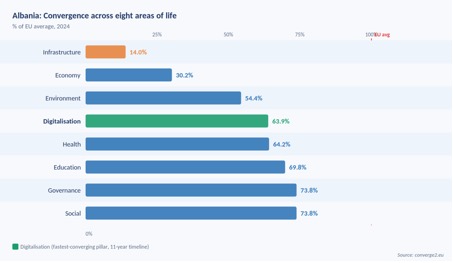
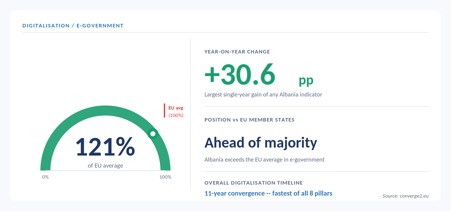
When converge2eu analysts reviewed Albania’s convergence data across eight areas of life, one result stood out. In e-government services, Albania reached 121% of the EU average in 2024, placing it ahead of a majority of EU member states. That number represents a gain of 30.6 percentage points in a single year. No other indicator in the Albania dataset moved that far, that fast.
Source: www.converge2.eu
Overall digitalisation stands at 63.9% of the EU average, with an 11-year convergence timeline. That is the shortest timeline of any of the eight pillars. Internet household access has already crossed the threshold entirely, reaching 104.2% of the EU average: full convergence achieved. Five years ago, neither figure looked plausible.
The speed matters. Albania did not approach this level through steady incremental progress. The e-government jump came primarily in 2023 and 2024, driven by the rapid rollout of the e-Albania platform across service categories that had previously required physical presence. The progress is concentrated, recent, and attributable to specific policy choices rather than background structural improvement.
That distinction shapes how the story should be read. This is not the accumulated result of a decade of quiet reform. It is a policy-driven acceleration in a narrow window of time, which means it is replicable, and also means it can stall if the conditions that produced it are not sustained.
The Platform Behind the Progress
The engine is the e-Albania platform, which has now digitalised more than 1,200 government services, covering everything from business registration and property certificates to social assistance applications and health records. The scale of that transformation is easy to understate. What it means in practice is that the interface between citizens and the Albanian state has been almost entirely rebuilt within the space of a few years.
For citizens, the shift is tangible. Administrative processes that previously required time, physical presence, and familiarity with bureaucratic procedure can now be completed online, tracked in real time, and resolved without contact with individual officials. For a country where the opacity and friction of public administration have historically undermined institutional trust, that change carries weight beyond efficiency.
The rollout has also been deliberately broad in scope. Services are accessible via mobile devices, reducing barriers for citizens outside major urban centres. Integration across government agencies means that fewer tasks require a citizen to navigate multiple offices for a single outcome. That structural design, rather than simply digitising existing paper processes service by service, is what separates e-Albania from more superficial digital government programmes.
What stands out is not only the speed of this transformation, but its architecture. Albania did not digitise any old system. It built a different one.
Strategic Choices Behind the Speed
The acceleration has institutional roots. From 2022 onwards, under the Digital Agenda 2022-2026, the Albanian government identified digital public services as a priority and followed through with coordinated investment across agencies. Two institutions were central: the Agency for the Delivery of Integrated Services Albania (ADISA) and the National Agency for Information Society (AKSHI), which coordinated platform development and ministerial uptake across the system.
International support reinforced the direction. EU instruments, including IPA III funding and the EU Growth Plan for the Western Balkans, have provided financing and a regulatory framework. Albania has aligned its digital governance architecture with EU standards, including the General Data Protection Regulation (GDPR) and the Network and Information Security Directive 2 (NIS2). Regional cooperation through the Digital Agenda for the Western Balkans, coordinated by the Regional Cooperation Council (RCC), has provided technical standards and interoperability frameworks.
The EU integration context has also shaped incentives in a less direct but important way. As Albania moves through formal accession negotiations, digital governance has become a visible signal of administrative capacity. The e-Albania results give the government a credible evidence base that state institutions can modernise quickly when political will and coordination are in place. That dynamic partly explains why the platform has received sustained attention from senior levels of government rather than being delegated entirely to a technical agency.
The driving force, though, has been domestic. This is a nationally owned project, shaped by domestic institutional priorities and political choices, not the product of external conditionality alone.
What EU Membership Could Add
Source: www.converge2.eu
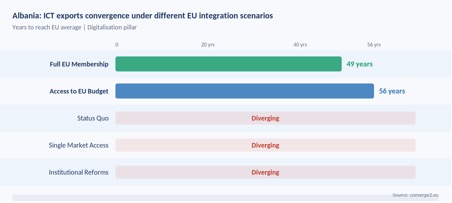
Converge2eu scenario modelling shows that full EU membership would accelerate Albania’s overall digitalisation convergence beyond current trends. For the ICT exports indicator specifically, however, the picture is more sobering. Under the status quo, ICT exports continue to diverge from EU levels. Only full EU membership or broad EU budget access shift the trajectory materially, with convergence projected at 49 and 56 years respectively under those scenarios.
That result points to a structural asymmetry in Albania’s digital position. The country has built world-class public digital infrastructure. It has not yet converted that infrastructure into equivalent private-sector competitiveness. EU integration accelerates the economic side of the equation more than the governance side, where progress has already been domestic-driven.
The Next Challenge: From Services to Value
Albania’s digital success story has a visible boundary. E-government leadership has yet to translate into equivalent strength in the digital economy. ICT exports stand at 18% of the EU average. ICT employment stands at 41%. Value added from the digital sector, at 53% of EU levels, points to a country that has built strong public digital infrastructure without yet converting it into sustained economic competitiveness. The gap between what the state has built and what the economy produces is the central unresolved challenge.
Closing it requires moving beyond infrastructure. A skilled digital workforce, functional innovation ecosystems, and stronger linkages between the public and private digital sectors are the structural prerequisites. Expanding STEM education, supporting ICT entrepreneurship, and attracting technology investment through the same strategic coherence that drove e-government reform are the logical next priorities.
There is also another dimension: resilience. The efficiency gains of the e-Albania platform depend directly on its reliability. A system that processes 1,200 government services can reduce bottlenecks across the economy only if it operates without interruption. Downtime, whether from maintenance gaps or external interference, does not simply delay transactions: it concentrates demand in ways that recreate the very friction digital government was designed to remove. Albania learned the full weight of this in 2022, when a state-sponsored cyberattack targeted its digital infrastructure and temporarily disrupted public services, one of the most significant incidents of its kind directed at a European government. The response accelerated investment in cybersecurity capacity and deepened cooperation with NATO and EU partners on digital defence. That experience produced something important: a government that now treats platform resilience and protection against hostile interference as a core condition of the digital state, not an afterthought. Sustaining that posture, ensuring that e-Albania remains secure, continuously operational, and hardened against future threats, is as much part of the digital agenda as any new service built on top of it.
Albania’s digital achievement will remain partial until the e-government model is replicated across the private sector. The platform has been built. Now each one of us needs to build on it.
Back to the Kitchen
Arta locks her front door and heads out into the street. She is on time. In the back of her mind is a faint awareness that something that once would have cost her a morning, maybe days, now cost her nothing.
She does not think of this as a policy achievement. She does not think of it at all.
Reforms that work eventually disappear into the background of everyday life. They become what people simply expect. Albania has built something that many governments in Europe are still working towards: a state that fits into a citizen’s morning without getting in the way.
That is what convergence looks like when it reaches people. 👉 Explore the full data and convergence scenarios at converge2.eu