On a June evening in Sarajevo, Amar is watching the Zmajevi.
So are millions of other Bosnians.
Some are gathered in cafés. Others are watching from their living rooms, on their phones during the night shift, or from thousands of kilometres away. Across four continents, Bosnia and Herzegovina’s diaspora is following the national team as it reaches the World Cup knockout stage for the first time in its history.
The match is more than football. It is a shared digital experience.
Streams, apps, smartphones and connected households bring the same game to people across a country divided by geography — and to Bosnians living abroad.
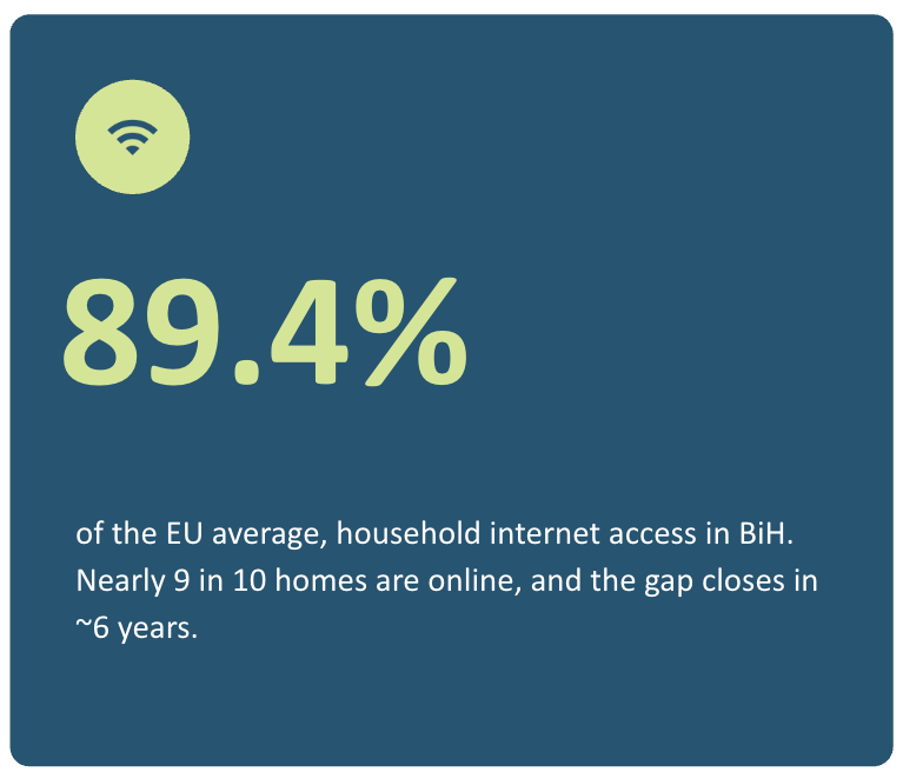
Almost nine in ten households in Bosnia and Herzegovina now have internet access: 89.4% of the EU average. At the current pace, the country could close that gap with the EU in around six years.
Source: www.converge2.eu
For Amar, that connectivity is something he takes for granted.
But it tells a bigger story. Bosnia and Herzegovina may be struggling to converge with Europe in many areas, but digitalisation is different. Here, convergence is happening in years rather than generations.
Bosnia and Herzegovina’s digitalisation performance stands at 70.8% of the EU average — making it one of the country’s strongest areas of convergence. While the broader economy could take more than a century to reach EU levels at the current pace, digitalisation is roughly three decades away. Some indicators are already remarkably close to, or even above, the EU level.
The most striking example is the ICT sector itself.
ICT value added has already reached 105% of the EU average. Household internet access stands at 89.4%, while the share of firms with websites has reached 84.7%. ICT employment is also on track to reach EU levels within roughly a decade.
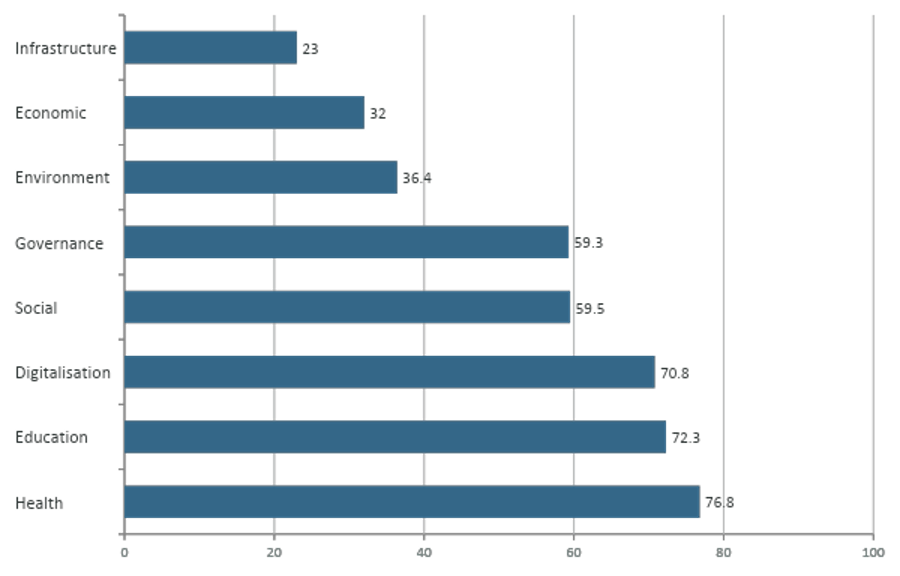
While the economy would need 100+ years to converge, digital BiH is ~30 years away — and its best indicators are already there.
This is not simply a story of government programmes catching up with Europe. It is largely a market-driven success.
Businesses invested. Citizens adopted new technologies. A generation of entrepreneurs and technology companies built an increasingly competitive digital sector without waiting for the state to catch up.
And that is where Bosnia and Herzegovina’s digital story becomes particularly interesting. Because there are, in effect, two digital Bosnias.
On one side is the Bosnia that citizens and companies are building themselves.
Fast. Connected. Entrepreneurial.
On the other is the Bosnia of public institutions.
Slower. Fragmented. Still catching up.
Source: www.converge2.eu
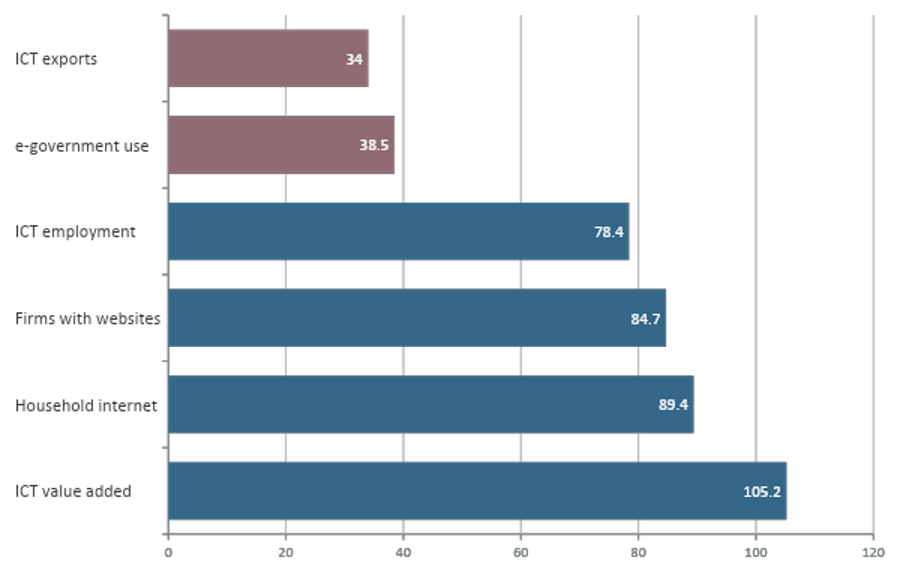
The contrast is striking. While ICT value added has already surpassed the EU average and household connectivity is approaching convergence, e-government use stands at only 38.5% of the EU average and ICT exports at just 34%.
For Amar, this is the frustrating part.
He can order something online from a company in Germany in minutes. He can open an account through a digital platform. He can sign documents electronically in many parts of his life.
But dealing with public administration can still mean forms, counters and waiting.
The technology is no longer the main problem. The state is.
Then, in July 2025, something changed. For years, one of the biggest obstacles to Bosnia and Herzegovina’s digital convergence was the absence of a state-level electronic signature and unified digital identity.
On 21 July 2025, IDDEEA launched the e-IDDEEA platform — a free national digital identity system for citizens and institutions, available through mobile and desktop platforms. It includes a qualified electronic signature and is certified under the EU’s eIDAS framework.
Suddenly, the missing infrastructure was there.
A citizen could potentially sign an official document from the sofa instead of standing in a queue.
Identity documents and other records could be accessed through the app. Banks and telecom operators could connect to the platform through APIs, opening the possibility of contracts and services without paper.
For Bosnia and Herzegovina, this is more than a convenience. It is a piece of European infrastructure.
Because eIDAS compliance means digital identities and signatures are built around the same trust framework used across the European Union.
The technology is finally catching up with the ambition. But there is a catch.
Bosnia and Herzegovina’s digital identity may now be technically solved. Politically, it is not.
The Republika Srpska Ministry of Interior has challenged IDDEEA’s authority over digital identity, raising a much bigger question: can one national digital identity really work everywhere in a country where institutions and responsibilities remain fragmented?
This is where Bosnia and Herzegovina’s digital convergence story becomes a story about European integration itself.
The country’s biggest digital bottleneck is no longer access to technology.
It is institutional fragmentation. A digital identity only becomes transformative if a citizen can use it everywhere — in Sarajevo, Banja Luka and every municipality in between.
A digital government only works if government services are actually available online. And a strong ICT sector only becomes a driver of convergence if Bosnia and Herzegovina can sell more of its digital capabilities beyond its borders.
The potential is enormous.
Converge2EU modelling shows that access to the EU single market could accelerate convergence in ICT exports dramatically: from more than 100 years under the status quo to around 25 years with EU single-market access. Institutional reforms alone would shorten the timeline only to around 88 years.
That makes EU integration more than a political destination for Bosnia and Herzegovina’s digital economy.
It could be its growth engine.
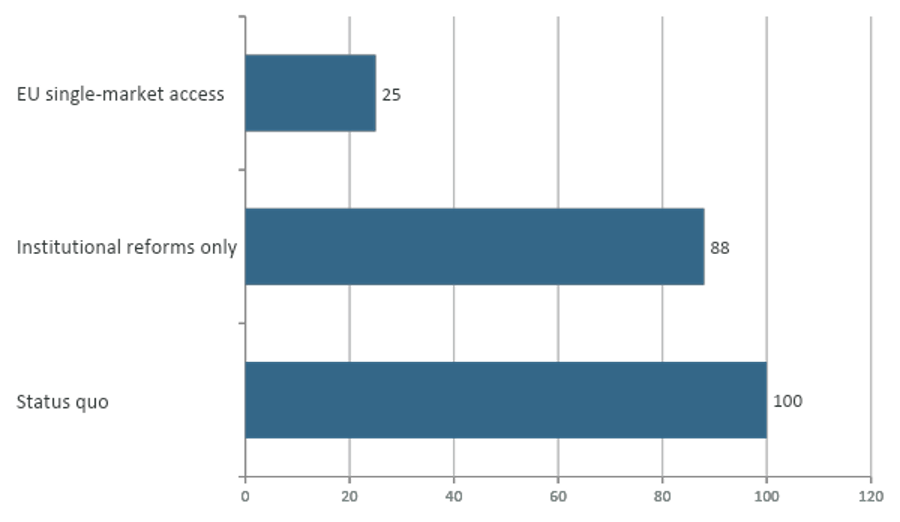
Domestic reform alone barely moves the needle (100+ → 88 yrs). EU integration is not symbolic here — it is the growth engine of digital BiH.
The priorities are therefore becoming clear: one digital identity that works everywhere, public services that citizens can actually use online, and a stronger push to take Bosnia and Herzegovina’s ICT sector into European markets.
For Amar, the difference could eventually be simple.
Instead of asking whether he can access a service online, he simply expects it to be there. Instead of navigating different systems depending on where he lives, one identity works across the country. Instead of seeing Europe as somewhere to go to find opportunity, he can increasingly see it as a market he can reach from home.
Back in Sarajevo, the World Cup match is reaching its final minutes.
The country is connected. The screens are everywhere. The diaspora is watching. The technology works.
But there is an irony in the story.
Even this shared digital experience is not completely open: the matches are being shown through regional pay-TV, while the national team is not being broadcast on the public broadcaster and free online streams can be geo-blocked abroad.
It is a small metaphor for Bosnia and Herzegovina’s digital journey.
The connectivity is there. The potential is there. The gates are what remain to be opened.
Bosnia and Herzegovina has shown that when citizens and businesses lead, convergence with Europe can happen remarkably quickly.
The next challenge is making sure the state can keep pace.
Because the country’s digital future will not be determined by whether Bosnia and Herzegovina has access to technology.
It will be determined by whether it can turn that technology into functioning institutions, competitive businesses and opportunities that connect its citizens — at home and abroad — more closely to Europe.
“Where the market leads, Bosnia converges with Europe in years, not generations — the task now is to let the state catch up.”
And perhaps that is the most important lesson from the Zmajevi’s historic summer:
Bosnia and Herzegovina is already connected to Europe. The challenge now is making sure it can fully participate.
Sources
Explore the full data: www.converge2.eu
Annual Convergence Report 2025 — Bosnia and Herzegovina & Western Balkans regional report
IDDEEA — e-IDDEEA launch announcement (21 July 2025) and eIDAS certification
FIFA World Cup 2026 records (UEFA, FIFA); regional broadcast-rights reporting (SportSport.ba, Bljesak.info)
5:["$","div",null,{"className":"bg-[#346686] relative max-h-content","children":[["$","div",null,{"className":"relative flex flex-col-reverse lg:flex-col","children":[["$","div",null,{"className":"relative lg:absolute inset-0 z-0 svg-map-center-mobile","children":["$","$L11",null,{"countries":[]}]}],["$","$L12",null,{}]]}],["$","main",null,{"className":"mx-auto main-content lg:px-16 py-6 relative pointer-events-none","children":["$","div",null,{"className":"relative w-full lg:w-2/3 mt-6 ml-auto pointer-events-auto","children":["$","div",null,{"className":"w-full 2xl:w-[100%]","children":["$","div",null,{"className":"about-container mb-4 xl:mb-6","children":[["$","$L13",null,{"href":"/news","className":"inline-flex items-center gap-1 text-white/50 text-sm mb-6 hover:text-white/80 transition-colors","children":"← Back to News"}],["$","h3",null,{"className":"text-lg md:text-lg lg:text-xl xl:text-[30px] text-white w-[70%] mb-3","children":"A Digital Bosnia, One Click Away?"}],["$","time",null,{"className":"text-white/40 text-sm block mb-8","children":"20 September 2026"}],["$","div",null,{"className":"post-module-scss-module__zSLlAG__wpContent","dangerouslySetInnerHTML":{"__html":"$14"}}]]}]}]}]}]]}]